
Our Vision
Sawmilling is still running on 1970. We're building 2026.
Same logs. Same machines. Different thinking — 2 to 4 points of recovery, permanently. We're building the Digital OS for sawmills, and the industry's source of truth on yield.
Same logs. Same machines. Different thinking — 2 to 4 points of recovery, permanently. We're building the Digital OS for sawmills, and the industry's source of truth on yield.
It isn't your saws. It's the decisions made above them — and a spreadsheet that records the past instead of managing the future.
Each shift's pattern is chosen without knowing which log grades arrive next week — or which product demand is shifting.
The sawline runs what's convenient, not what's needed — overproducing low-priority dimensions while customer orders wait.
Spreadsheets record what happened. They can't evaluate thousands of combinations or look weeks ahead — and the know-how lives in one person's head.
SawmillSmart isn't a feature list. It's a position on what's wrong with sawmilling — and what would fix it.
Excel is great at recording what happened and terrible at deciding what happens next. A mill that runs on Excel is running on a postmortem of itself — the plan is always one step behind reality. Management means simulating the future and choosing, not annotating the past.
Every modern mill has spent millions on scanners, optimizers and edgers — each adding 0.5–1% recovery. But the layer above them — what to cut, when, against which orders — still runs on intuition. That's where the next 2–4 points live, and they cost nothing to install.
This isn't our number — it's published in Computers & Electronics in Agriculture (Elsevier). When raw material is 60–70% of production cost, recovery is the most leveraged variable in the entire operation — yet the least optimized.
Toyota didn't win with better machines — it won by optimizing flow across the whole system. Most mills still optimize each log in isolation. The margin is in the flow.
Years ago our founding team — then in consulting — was called into a mill with modern scanning equipment and recovery that should have been industry-leading. Instead output sat at 50,000 m³/year and nobody could explain where the yield was going.
Three weeks in, the answer was obvious: the equipment wasn't the bottleneck — the planning was. The scanners knew each log; the optimizer knew the best pattern per log. But no one was thinking about thousands of logs at once, against the real order book, over multiple weeks.
We built a prototype during the project. The first results were uncomfortable: the current plan was leaving millions in the chip pile. The mill implemented it, and annual savings — validated by their own finance team — reached €6–7M. Then we realized every mill we visited had the same gap. So we left consulting and rebuilt it as SawmillSmart.
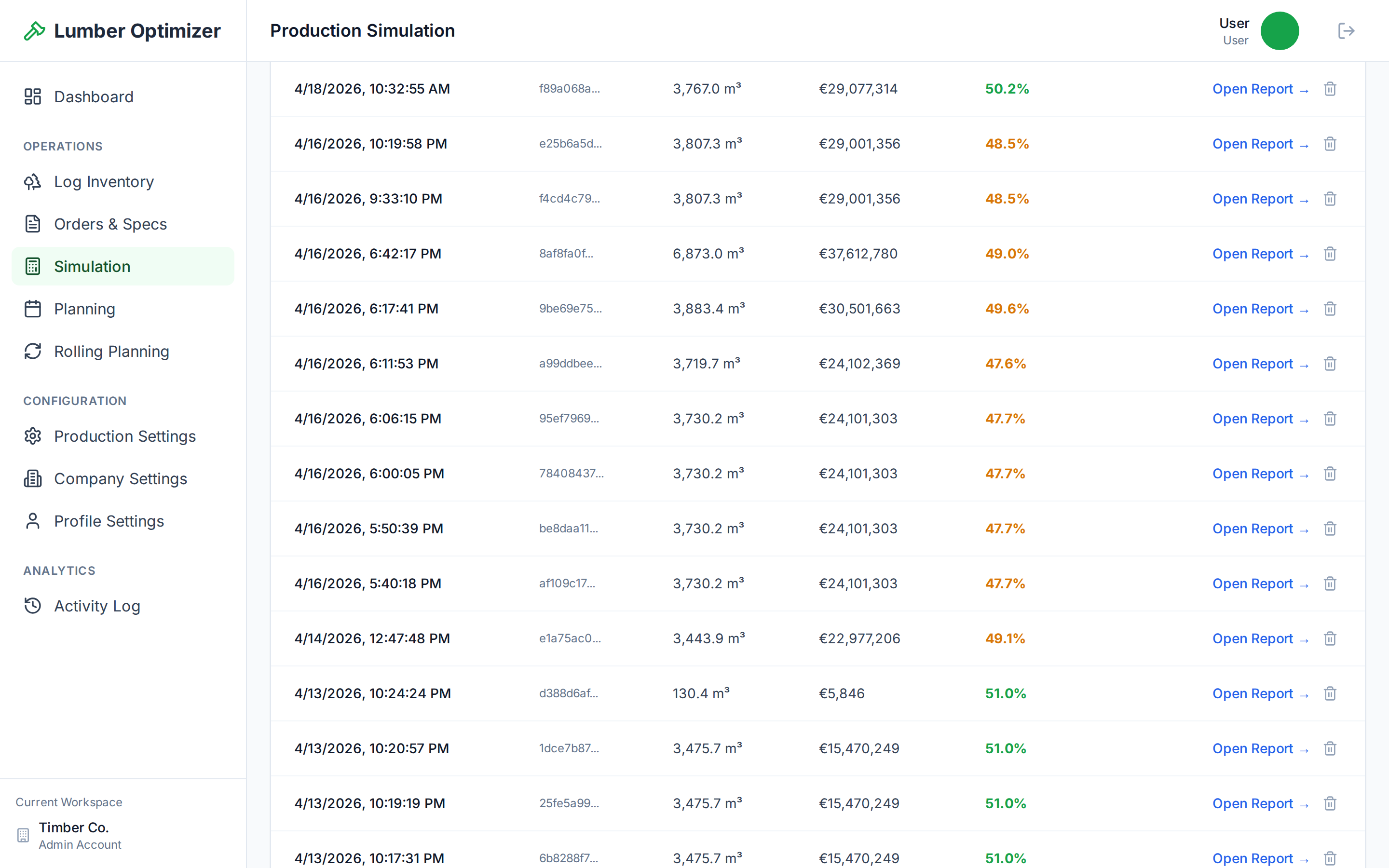
Four modules — inventory, orders, cutting simulation, rolling-horizon planning. Scandinavian and frame/breakdown lines. The Excel-replacement layer that recovers 2–4 points of yield.
Finished-goods inventory, procurement intelligence, deeper order-to-production planning, 17 EU languages, and a free-tools hub for the industry.
Anonymous benchmarking, AI-assisted procurement, predictive maintenance from decision history, carbon reporting — the default planning system European mills choose.
ROI calculator, shrinkage calculator and an EUDR self-check — free, no email required. See the yield gap on your own mill in minutes.
Most vendors push you straight to a sales call. We give you three lower-barrier entry points — a demo comes only when you're ready.
Deep-dives on yield, planning and operations. No email required.
Browse the blog →ROI and shrinkage calculators, EUDR self-check — run your own numbers instantly.
Open free tools →See SawmillSmart run on your real mill data — a working session with our team, no commitment.
Request a Demo →Book a demo and we'll walk through it on your real data — a working session with our team, no sales pitch.